Choosing a good dog name

Choosing a great dog name

Cavoodle sittingNaming your dog can be a challenge but it’s important to remain sensible about the whole process. Names can alter peoples’ perception of your dog so it’s important you choose a name appropriate to the image you want to invoke. If you want a favourable reception, then a name like “Rambo” may not be in your dog’s best interest. However, if the objective of the name is to instill fear in the surrounding populace then go right ahead, but it might be time to seriously consider a change of neighbourhood.

Popular Dog NamesYou’re going to be using the name of your dog a lot so it’s important you take your time in choosing something suitable. You don’t have to name them right away as soon as you get them home. Leave it for a while as you get to know the animal, and let its personality shine through after they have had enough time to settle into their new surroundings. As you go through your list of options something will eventually stand out as the perfect moniker for your new dog. To get your list started here are a few ideas for inspiration:

Famous people are a good place to start for your shortlist of options. Add the names of famous people, past and present, who inspire you such as Edison, Einstein, DaVinci, or Napoleon. Take your pick from movie stars and singers such as Ginger or Jackson, or cartoon characters like Snoopy and Charlie Brown.  Even food can provide you with inspiration, and it will have a lot do with your dog’s personality and the colour of their coat with names such as Hotdog, Peaches, and Nutmeg springing to mind as great examples.  

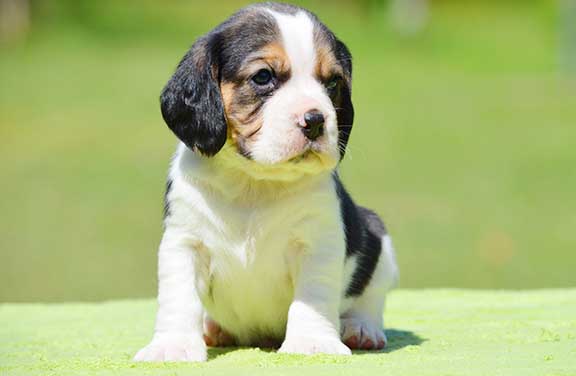
Tan and white BeaglierYou will be most likely be calling out to your dog where other people can hear so a name that is not embarrassing or cruel is a must. As you are going to be using the name often, short and simple is also the most sensible choice over something that may be overly long, or hard to pronounce.

Also, stay away from names that are similar to other names in the household (such as Mike and Spike) to avoid confusion should your dog think it is being called when it’s not. Dogs who are constantly ignored when they think they are being called will eventually stop responding to that name altogether.

Groodle puppy runningMost training commands are one syllable words, e.g. sit and stand, so two syllables at a maximum should be used for your dog’s name. This will make it easier for her to distinguish between her name or a spoken command. You should also consider a name that starts with a hard or stop consonant as this will also make it simpler for them to distinguish when they are being spoken to.

And finally, while it may be tempting, if you regularly take your dog out to where there lots of other dogs, you may want to avoid the names on the current top 10 lists for dogs. You don’t want 4 other dogs getting confused every time you need your dog’s attention or your dog to go to other people calling their dog.

Popular Dog names

Popular Male Dog Names:                         Popular Female Dog Names:

Aaron
Ace
Adalberto
Adrian
Al
Alden
Aldo
Alexis
Allen
Alphonso
Alton
Alvin
Ambrose
Amos
Andy
Anibal
Anthony
Antone
Antwan
Apollo
Arnold
Art
Bailey
Bandit
Barney
Barrett
Baxter
Bear
Beau
Benji
Benny
Bentley
Billie
Blue
Bo
Boomer
Boris
Bradford
Brady
Branden
Brendon
Bret
Britt
Brody
Bruce
Bruno
Bruno
Brutus
Bryant
Bubba
Buddy
Buster
Calvin
Carl
Carlo
Carol
Carol
Casey
Cash
Chadwick
Chance
Charlie
Chase
Chester
Chewy
Chico
Chong
Chuck
Clarence
Clark
Clayton
Coco
Cody
Cody
Cole
Cooper
Copper
Cornelius
Cornell
Dale
Dalton
Damien
Danial
Danilo
Darius
Darrick
Darryl
Daryl
Deandre
Demarcus
Desmond
Dexter
Dexter
Diesel
Domenic
Dominic
Donnell
Donny
Duke
Dustin
Dusty
Edmundo
Edward
Efrain
Efren
Eldridge
Elliot
Elliott
Elmer
Eloy
Emerson
Emile
Emmett
Ernesto
Ethan
Eugene
Eugenio
Everett
Everette
Fausto
Federico
Felix
Finn
Francisco
Frankie
Franklin
Frederick
Gail
Garland
Gavin
Gene
George
Gerardo
Gil
Giuseppe
Gizmo
Gunner
Gus
Hank
Hank
Harley
Harrison
Hayden
Henry
Herb
Herman
Houston
Hoyt
Humberto
Hunter
Ian
Ike
Ira
Irving
Jack
Jackson
Jake
Jamar
Jamel
Jan
Jared
Jasper
Javier
Jax
Jean
Jed
Jeromy
Jerrell
Joan
Joey
Johnathon
Jordon
Julian
Julius
Kareem
Karl
Kelly
Kent
Kenton
Kevin
Kim
Kirby
Kobe
Koda
Kristopher
Lance
Laurence
Lavern
Lawerence
Lenard
Leo
Leon
Les
Leslie
Lindsay
Lindsey
Loki
Louie
Loyd
Lucky
Luke
Lynwood
Mac
Mac
Mack
Marc
Marcellus
Marcus
Maria
Marley
Martin
Maurice
Maverick
Max
Max
Merrill
Mervin
Michal
Mickey
Miles
Milford
Milo
Mitchell
Moose
Morgan
Morris
Morton
Murphy
Myron
Nathan
Nathanial
Newton
Nicholas
Noble
Numbers
Oliver
Ollie
Omar
Omer
Oreo
Oscar
Osvaldo
Otis
Otis
Pablo
Pat
Peanut
Percy
Perry
Philip
Porfirio
Prince
Quincy
Rafael
Randell
Ranger
Raphael
Rashad
Reggie
Rex
Richard
Rick
Riley
Roberto
Rocco
Rocco
Rocky
Rodger
Rolland
Roman
Romeo
Ronny
Roosevelt
Rosario
Roscoe
Rudy
Rudy
Rufus
Russel
Russell
Rusty
Salvador
Sam
Sammy
Samson
Samuel
Scooter
Scott
Scout
Shadow
Shane
Shaun
Sheldon
Shelton
Simba
Sparky
Sterling
Sylvester
Tank
Teddy
Theo
Theodore
Theron
Thor
Tobias
Toby
Tommy
Tuan
Tucker
Tyrell
Tyson
Van
Vernon
Vincenzo
Waldo
Walton
Warner
Waylon
Wes
Weston
Wilbert
Williams
Wilson
Winston
Wm
Zackary
Zane
Zeus
Ziggy
Abbie
Alejandrina
Alesha
Alethea
Alica
Alida
Allie
Alline
Allyson
Alona
Angel
Anika
Anita
Annamaria
Annette
Annie
Athena
Ava
Baby
Bailey
Bebe
Becky
Bella
Belle
Bethany
Betsy
Beula
Bonnie
Brandee
Bree
Brenda
Callie
Camellia
Candi
Cari
Carissa
Carleen
Carlena
Carley
Carline
Carlota
Carmina
Caryl
Casandra
Catherin
Cecilia
Chana
Charlie
Chloe
Christie
Clemencia
Cleo
Cleta
Coco
Cocoa
Contessa
Cookie
Cora
Coral
Corrine
Crystle
Dagny
Daina
Daisy
Dakota
Danae
Danielle
Danika
Dannette
Danuta
Darlene
Davina
Daysi
Deandrea
Debbi
Deidre
Delfina
Delilah
Delphia
Denita
Dessie
Diane
Dianna
Dixie
Dollie
Dolores
Doreen
Dorothy
Dorthy
Ebony
Eleanor
Eleanore
Elenora
Elicia
Ella
Ellie
Else
Ema
Emelia
Emma
Erma
Esther
Eusebia
Evette
Evon
Fiona
Flor
Francesca
Freda
Geneva
Genevive
Georgianna
Gigi
Ginger
Golda
Golden
Grace
Gracie
Hannah
Harley
Hazel
Heidi
Holly
Honey
Hui
Hyo
Ilana
Inocencia
Izzy
Jackelyn
Jacqualine
Jacquline
Jacqulyn
Jaleesa
Jalisa
Janey
Janise
Jannie
Jaquelyn
Jasmine
Jeanett
Jena
Jennefer
Jessenia
Joella
Johna
Johnsie
Josie
Josie
Joy
Judi
Karima
Karlyn
Karoline
Kasha
Kathaleen
Kathlene
Katia
Katie
Kay
Kelsie
Khalilah
Kiana
Kiara
Kimberlie
Klara
Kona
Kristeen
Lacey
Laci
Lady
Lakeesha
Lakisha
Lannie
Larae
Lashanda
Layla
Leah
Leandra
Leatha
Leia
Lelia
Lena
Leonie
Leonora
Lera
Lesa
Leta
Lettie
Lexi
Lexie
Liliana
Lilliana
Lilly
Lily
Linh
Lissa
Lita
Lola
Loma
Londa
Lorrie
Lovie
Lucky
Lucy
Lulu
Luna
Macy
Maddie
Madeleine
Madie
Madison
Magali
Magda
Maggie
Magnolia
Maira
Mammie
Maple
Margo
Marguerita
Marina
Marley
Marvella
Maryanne
Maya
Meagan
Meg
Mia
Milda
Millie
Mimi
Minnie
Miriam
Missie
Mocha
Molly
Monserrate
Mora
Nala
Natisha
Natosha
Nelda
Nevada
Nikki
Nina
Nisha
Nubia
Nyla
Olive
Oreo
Paulina
Peanut
Penelope
Pennie
Penny
Pepper
Phoebe
Pinkie
Piper
Pricilla
Princess
Regenia
Renate
Riley
Rivka
Rosalia
Rosaria
Rosie
Roxie
Roxy
Rubi
Ruby
Rufina
Sacha
Sadie
Sadie
Sally
Sandy
Sasha
Sassy
Scout
Shadow
Shana
Shanta
Shari
Sharonda
Sharyn
Shea
Sheena
Shelby
Shellie
Shenika
Sherita
Song
Sophie
Sophie
Steffanie
Stella
Sueann
Sugar
Sydney
Tabitha
Tambra
Tenesha
Tera
Theresa
Tinisha
Tona
Torri
Tova
Trish
Trixie
Tyesha
Verdie
Vernetta
Vesta
Vonda
Williemae
Willow
Winnie
Yasmin
Yasmine
Yesenia
Yuki
Zana
Zenia
Zoe
Zoey

Feeding a new puppy

Feeding a New Puppy

Cavoodle-Puppy-blackWhen bringing a new puppy home, there are many considerations to be made.  Where will the new puppy sleep?  Which rooms of the house will he be allowed in?  How many toys should we buy him?  The most important consideration, however, is what the puppy will eat.  Below is a guide for proper puppy feeding.

Young puppies should be kept on the same diet as what the breeder has been feeding them for the first 2 weeks at a minimum and then very gradually weaned off this food to another if you decide to change it.

Beaglier ears backPuppies have different nutritional needs than an adult or senior aged dog, and should therefore be fed a high quality food specially formulated for their age.  The best puppy food will have a high protein ratio from whole ingredients.  For instance, look for chicken meat on the label instead of chicken meal or chicken by product.  Additionally, puppies require extra vitamins and minerals to help keep their growing bodies healthy, so look for a food that is high in calcium and other minerals.

If your puppy is not already eating solid food when you receive him or her, you should gradually wean your puppy from puppy milk.  From the age of 6 weeks and on, you can begin to mix solid food with the puppy milk.  Each day over the course of one to two weeks decrease the amount of milk in the mixture.  At the end of the timeframe your puppy should be eating 2 – 3 small meals of solid food per day.  Not only do small meals keep your puppy’s energy levels constant throughout the day, but they are also easier to digest.  Once your puppy’s growth rate has slowed down (typically around 6 months of age) you can begin to feed him only two meals per day.  However, if your puppy is a large breed or one prone to gastric torsion (also known as bloat) then maintaining the 2 – 3 meals per day feeding schedule is best.

Puppies eatingThe amount of food you feed your puppy at each meal is dependent on breed and size. A Cavoodle will need less food than a Beaglier for example. Be sure to follow the guidelines listed on the food package, the breeder or consult a veterinarian.  Remember that it is important not to allow your puppy to become overweight, as obesity is the leading cause of health problems in dogs.

Your dog should stay with puppy food until he has reached full maturity.  For small dogs, they can begin eating an adult formula when they reach 8 – 10 months of age.  Medium sized dogs reach maturity between 10 and 12 months of age, while larger dogs such as Standard size Groodles may not be ready for an adult food until they turn 18 months old.  Additionally, your dog may indicate it is time for new food if he stops finishing meals or begins to put on excess weight.  If in doubt, considerations such as these are best discussed with a veterinarian.  When changing your puppy’s food it is best to do so gradually to avoid the risk of upset stomach or diarrhea.  Over the course of one week, mix increasing amounts of your dog’s new food with decreasing amounts of the old food.  Always be sure to read labels, as the amount your dog requires with the new formulation may be different than with the old.

Safe Car Travel

Groodle out of carWhen the whole family is going for a holiday, or even just a day trip, many families like to include their dogs in the expedition. After all, why should only people get all of the fun? Most dogs love a car ride but a few may need to be trained and conditioned for it. Start gradually with short rides and they will become accustomed to it over time – at which point you can safely start to increase the time and distance of each trip.

This Groodle loves to go for car rides but should be kept inside the car for his own safety.

Keep dogs restrained in the car

Dogs who are free to jump around inside the car while travelling are in danger of becoming injured. Train her to lie down on the back seat so they are unlikely to fall should you need to break all of a sudden. If she is travelling with you in a two seater vehicle, then have her lie down in the passenger seat next to you.

Groodle in car

It’s important to mention that no dogs should be travelling with you unrestrained while in the back of a ute. Many a dog owner has reached the end of their journey only to realize that their trusty companion is no longer with them. Even tied up they are at risk of hanging themselves if thrown free, or may sustain serious (and possibly preventable injury) in the event of an accident.

Dog safety products

There are quite a few companies who manufacture accessories for your vehicle to make travelling with pets a lot easier and safer. Pet barriers work well for minivans, wagons, or SUVs which give your pet room to stretch their legs while they remain safely constrained behind the rear seat.  A harness or restraint may suit some dogs, but look for one that allows your dog the freedom to sit or lie down. Beds from home will provide a level of security and comfort for your pet but you could also consider getting one specifically for the vehicle. Older dogs will also appreciate a ramp that allows them to get into and out of the vehicle without the need to jump if they are too big to be lifted into the car.

Dogs and open windows

Groodle car rideDogs are a lot like little kids and love the feel of the air rushing past them as they stick their heads of an open window. Of course, this is very unsafe, so ensure your windows are not wound down far enough for them to do this. This is even truer for smaller dogs who may be able to jump through a window should it be left open.

Long trips require a little planning. You will need to carry a bowl and some water, a lead, and some snacks for your dog. Every couple of hours have a rest stop, let the animal stretch its legs (and you as well), and have a bit of a snack before resuming the trip.

How to teach your dog to shake hands

Teaching your dog to shake hands

Although shaking is a fun party trick, it is also very useful for when your dog needs to have his nails trimmed, or has something stuck in his paw.  A dog that is comfortable with shaking will also be more comfortable allowing you, a veterinarian, or a groomer handle his feet, which is important for the health and safety of your pet. On top of this, a dog that can shake hands is always a hit with the kids!

Groodle Shake hands

Steps to teach your puppy to shake hands

To begin, ask your dog to sit.  Show your Groodle a treat, place it in your hand, and make a closed fist.  Place your fist low to the ground, a few inches in front of the paw you would like your dog to shake with.  Most dogs will paw at the hand to try and access the treat.  When your dog does this, immediately reward him.  After following this same routine a few times, begin to incorporate the “shake” or “paw” command. 

A slightly different way to teach to shake

A second way to teach a dog to shake also begins with asking your dog to first sit.  Then, hold a treat above his nose, and move the treat backwards, above his head and towards his tail.  Your dog’s weight will shift to his back legs, and he will begin to lift one or both paws.  Catch one of his paws and reward your dog as soon as his paw touches your hand.  Eventually, add in the verbal command.  This can be used to teach a separate trick of “high five”.

For extremely stubborn dogs, an effective, but more time-consuming method, is to first ask your dog to sit and then physically lift his paw while saying shake, and issuing a treat.  While it may take your dog a few days, or even weeks, to catch on, he will eventually learn that the act of placing his paw in your hand earns a tasty treat. 

Shake with the opposite paw

To teach your dog to shake with the opposite paw, simply repeat the method that worked best for your dog, but use a different command, such as “left.”  When teaching your dog to shake, there is no “wrong” method, but as with all other obedience lessons, be sure to have patience and issue plenty of positive reinforcement. 

Once your dog can reliably shake hands or give a high five, kids will be drawn to the dog. Most kids don’t want to miss out on a high five from a dog. Also if you have kids yourself, they will love to show off the dog’s cool new trick to friends and relatives, increasing the strength of the bond between the dog and your children. The more commands your dog receives from your kids, the stronger the association it has between following commands from the kids and getting a reward. This further cements the dog as lower in the pack than the kids in the dog’s mind.

How to teach your dog to Heel

Teaching your dog how to heel

Have you ever had someone comment, “Who’s walking who?” while out for a walk with your pup?  If so, you likely should teach your dog to heel, which means to walk by your side on a loose leash.  Not only does a proper heel save your shoulder from the strain of a pulling dog, but also ensures proper control during potentially dangerous situations, such as when walking through traffic.  Heeling is intended for short durations, and not for long walks.  For a proper heel, your dog should also sit when you stop walking.

Spoodle Heel

Steps to teach your dog to heel

To begin, find a quiet, distraction free area and place your dog on leash.  With your dog on your left side, lure him to sit (avoid asking for the sit).  With the leash in your right hand and a treat in your left hand, take a step forward, using the treat to lure your dog into the proper position by your side.  Move the treat forward or backwards to ensure he remains directly next to you.  Move only a few steps forward before stopping and rewarding your Spoodle for correct positioning. 

If your dog struggles with getting ahead of you or falling behind, try holding the treat next to your shoulder, so that your dog’s upward gaze will keep his body aligned with yours.  Once you find the technique that works best for you, enthusiastically reward him every time he is in proper position. 

If your dog strays from your side, tell him “no” and start over.  Practice this skill until your dog can reliably walk 5 – 7 steps in the proper heeling position before adding the verbal command of “heel” as you walk.  Only when your dog has mastered controllably walking by your side should you begin to have him sit the moment you stop walking.  Simply use a hand gesture, or, if having difficulty, verbally ask for a sit in addition to the lure. 

What to avoid doing when teaching your puppy to heel

There are a number of things to avoid when working on heel.  First, be careful to hold the treat high enough so that it is a guide for your dog.  Otherwise, he is likely to try and jump and grab at it with his mouth when he should be nicely walking.  Second, do not use the leash to pull your dog into the proper position.  It is very important that your dog perform the heel on a loose leash, or else he will come to rely on the restraint. 

Be sure to be vocal throughout the walking portion of the heel by giving your dog constant positive feedback for good positioning (i.e. good boy, good heel, etc), as well as negative feedback (i.e. “no” or “uh-uh”) if your dog is not in the proper position.   Finally, avoid only practicing with your dog on leash.  Working on heel off leash in the house, and also in the backyard, will drastically improve his ability to walk nicely next to you on command during your next walk. 


Teach your dog to come to you

How to teach your dog to come when called

One of the most important lessons a dog can learn is to come when called.  A reliable recall can literally mean the difference between life and death, such as in a situation when a dog gets loose and runs towards a busy street.  Recall is easy to teach, but must be amply rewarded with a lot of positive reinforcement in order for the lesson to stick with the dog. 

Standing Pugalier
Image courtesy of Chevromist Kennels

Steps to teach the “recall” command

To begin, first ensure that your dog knows his name and that you can easily get his attention.  If not, practice by using a treat to lure your dog’s gaze towards your face while saying his name.  Once your dog learns to look to you, you can begin to teach him the “come” command. 

Start with your Pugalier a short distance away from you, either on a leash or in an enclosed area.  It may be helpful to enlist the help of another person to hold your dog’s leash for you while you work on this command.  Wait until your dog is not paying attention to you, and then call his name.  When your dog looks to you, begin running backwards while excitedly saying “come” or “here.”  Your dog will think you are playing a game, which will make learning recall fun.  As soon as your dog runs to you, immediately reward him with lots of treats and praise.  Gradually increase the distance between you and your dog as he becomes better at this skill. 

Always reward your dog as though his obedience is the best thing that has ever happened.  This action will reinforce that coming when called is fun and exciting, better than anything he may be unsafely running towards. 

Patience is needed with this command

A reliable recall may take longer to teach than other commands, so patience is important.  Never continually yell “come” or “here” if your dog is not paying attention.  Doing so can teach him that it is okay to ignore you.  When practicing recall in extremely distracting environments (such as when rabbits, possums, or other dogs are near), use especially high-value treats such as pieces of meat or cheese.  To avoid the hassle of trying to get your dog’s attention by calling his name in distracted environments, first offer the treat, then yell the command as he is running toward you.  He will still learn word association in this manner. 

A good rule of thumb is to limit the use of the command for instances when the dog’s fun has to stop.  For instance, to get your dog to come in from the yard, avoid using “come” and try “go inside” instead.  Doing so can ensure that your dog will only associate “come” with treats and praise.  As with all important obedience commands, continuing practicing recall long after your dog has mastered the skill to ensure it remains reinforced throughout this lifetime. 

Dog Fleas

FleasOf all the common insects and parasites that can affect your dog, fleas are among the most annoying.  Not only do they cause discomfort to your pet, but if not treated immediately they can spread to the rest of the house and even bite human family members.  Both long coat breeds such as Cavoodles and short coat breeds such as Puggles are just as susceptible to these annoying parasites. Listed below is what you need to know about fleas, as well as how to treat and prevent them. 

Where do fleas come from?

Fleas are native to wooded areas, such as forest or scrub land, but will happily take up residence in shrubs, bushes, or anywhere they can find crevices to hide out until a potential host comes by.  As animals pass by these areas, fleas jump from brush to animal in search of a meal of blood from this host animal.  A dog can get fleas from being outside or near another animal that is already infested, as well as from birds or rodents that visit the backyard unbeknownst to everyone who lives there.

What are the symptoms of fleas?

flea-dirt-or-poo
“Flea dirt”

Initial symptoms of fleas include excessive scratching and shaking, especially at the base of tail or on the head, where most blood is concentrated.  To check for fleas, pull back your dog’s fur to look at the skin.  Fleas will look like moving black or brown thin bugs, and in a particularly bad infestation may reveal literally hundreds of fleas on a dog. “Flea dirt,” which looks like specks of black soil in the dog’s coat is usually what gives the presence of fleas away. It is the flea ‘poo’. If you are not sure if what you are seeing is dirt or flea dirt, take some of the grains and place them on a wet paper towel. The dirt will stay black while the flea dirt will go red when smudged into the paper towel. 

How should fleas be treated?

A flea infestation should be treated as soon as possible.  The first step is to treat the dog by administering a flea bath or spray.  These products contain insecticides that kill adult and juvenile fleas, or render them unable to reproduce.  Next, the entire house must be treated, as well.  Once the flea is finished sucking your dog’s blood, it will find a place to lay its eggs, such as upholstery or carpet.  It is important to kill any remaining fleas in the house, or else the flea cycle will continue.  Products are available at pet stores to help with this process. In extreme cases, an exterminator may have to be called.  Additionally, it is recommended to treat your house and dog multiple times to ensure all remaining fleas are killed.

What diseases do they spread?

Besides causing allergic reactions in many dogs, fleas can also contribute to the spread of disease.  If a dog uses his mouth to bite and scratch at fleas and accidentally ingests the insect, he is at risk for developing a tapeworm infection.  Tapeworms live inside an animal’s digestive tract and steal vital nutrients from the animal’s diet.  Extreme infections of tapeworm lead to weight loss and anemia. 

How can fleas be prevented?

Fortunately, fleas are entirely preventable.  A number of products exist that are designed to be regularly administered to dogs.  One option is a topical gel or liquid, applied monthly, that contains an insecticide that is metabolized by the dog’s skin.  When a flea bites a treated dog it ingests the insecticide and is killed on contact. Some of the brands of these topical preventative treatments include brands such as Frontline and Revolution. Other popular options include monthly oral tablets or topical sprays.  Additionally, some products are multifunctional and combine heartworm, flea, tick, and worm protection.  Overall, fleas are one of the easiest problems to prevent, and a small investment for monthly protection more than outweighs the cost of treatment. 

Teaching your dog to stay

How to teach your dog to “stay”

After your dog has mastered sit and lie down, he can begin to learn stay.  Just as with “come,” “stay” is a command that can help keep your dog safe, and is especially important for people without fenced in yards, or apartment dwellers that need to make sure their pup doesn’t run outside every time the door is opened.

Beaglier Stay 

Steps to follow

To begin, first put your dog in a “sit” or “down” position.  Say “stay” and hold your hand up as you take two or three steps backward.  Then, put your hand down and say “free” and encourage your dog to come to you.  As soon as your dog leaves the sitting or down position, issue a reward and positive reinforcement.  If your dog moves before you tell him he is “free,” say “no” and start the process over.  In the beginning you may find it necessary to shorten the amount of time you are asking him to stay, as some dogs have shorter attention spans than others.  Over time you will be able to lengthen the duration of the command, but remember to always release him by saying “free” (or something similar like “ok”) or else your dog may become confused and think he can break the stay without being told to do so.  Once your dog can stay for 10 – 15 seconds, begin practicing the command with a greater distance between you and your dog. 

Some things to keep in mind

Stay can be a difficult command for dogs to learn, because they naturally want to be near their owners (and, after all, you have probably already taught him the benefits of coming when called!)  If your Beaglier continues to break the command, calmly tell him “no” each time.  Feedback is important, and will help your dog learn that moving without being told do so is inappropriate.  Also avoid placing a treat in the hand being used to signal “stay.”  Seeing the treat will further entice the dog to run towards you.  As with all important commands, practice and positive reinforcement is crucial.  Treat your dog as if he just found a million bucks the first time he nails “stay,” and you will find that subsequent practice sessions will be easier. 

Also, keep in mind that the younger the puppy, the more time you may need to spend in teaching her a new command. Younger puppies also have shorter attention spans so keep the training sessions shorter than you think they can handle.

Dog worms

Vet with MoodleThere are many factors that go into properly caring for a dog.  Besides providing food, shelter, and love, owners should also provide routine veterinary care, vaccines, and necessary parasite preventatives.  Worming your puppy is important, yet is all too often overlooked by well-meaning pet parents. It is easy to forget and often, most owners don’t really think about them unless they see their Moodle rubbing his bum on the floor.

What are worms?

Worms are intestinal parasites such as roundworm, hookworm, tapeworm, and whipworms that use a dog’s (or other host animal’s) intestinal tract as a place to live.  The worms take nutrients from your dog’s food in order to survive, leaving your pet weakened and suffering from poor nutrition. Heartworms live in your dog’s circulatory system (the bloodstream) with the adults residing in the heart of affected dogs.

Roundworms

Dog roundwormDog roundworms (Toxocara canis) are the most common worm parasite of dogs and almost all dogs will have them at some stage in their life. They are picked up in a number of ways and can be passed on to people when basic hygiene such as hand washing is not followed after being exposed to infected dogs or their stool. They look like little lengths of noodles in the feces of puppies but are usually not seen until the puppy is given a worming tablet or syrup and the worm passed is usually a dead one.

Heartworms

Dog HeartwormThankfully, heartworms are less common in Australia than most other dog parasites but they can cause the most damage to an infected dog. Dog heartworms cannot be transmitted to people which is a good thing, considering that they are spread by mosquitos and they are almost 100% preventable in dogs with modern treatments. Heartworm preventatives need to be given from about 4-5 months of age. If you wait until after your puppy is 6 months old to start heartworm treatment, your vet may need to perform a blood test first.

Where do worms come from?

Dogs can contract worms in a number of ways.  Heartworm is transmitted to dogs through mosquitoes, while a dog may get roundworms from eating soil or stool from other animals, including rodents.  Hookworms can infect dogs in a similar manner as roundworm, but can also work their way through an animal’s skin and into its blood stream.  Whipworms come from consuming infected food or water, and tapeworms are the result of ingesting fleas. 

What are the symptoms of a dog with worms?

A dog that has been infected with intestinal worms will show any number of symptoms depending on the species and severity of worm infestation including coughing, “scooting”, diarrhea, vomiting, sudden weight loss, distended stomach, anemia, pale gums, or even death in long term and severely infested dogs. 

How are worms treated?

Depending on the type of infection and severity, worms can be treated in a variety of manners.  Most often, for infections such as roundworm, whipworm, hookworm, or tapeworm, a common dewormer such as Drontal puppy suspension is administered.  This treatment kills worms in the digestive tract, and typically multiple treatments at regular intervals are required. Just remember to weigh your dog as a Standard Groodle will weigh more and need a larger dose than a small breed such as a Moodle. For severe cases such as heartworm infection, antibiotics, steroids, and even surgery may be necessary.  It is far better to administer a preventative than to try to treat heartworm infestation.

How are worms prevented?

Regular deworming is an important preventative measure that kills any existing parasites in a dog’s intestinal tract before they can grow and cause harm to the pet.  Puppies, who are most at-risk from worm infestation, should be administered a deworming tablet or gel at 2, 4, 6, 8, 12, and 16 weeks of age, and then again every 3 months.  Beyond one year of age, dogs should be dewormed about once every three months.  For heartworm prevention, dogs should be administered a separate preventative, typically in the form of a monthly oral tablet, but once per year injections are now available from your veterinarian. Usually this is given at the same time as your dog’s annual vaccination. 

Teach your dog to lie down

How to teach your dog to lie down

Once a dog has mastered sit, he can begin learning how to lie down on command.  Not only is lying down a neat trick that makes your dog look well behaved, but it can also be useful for calming excited dogs or as an antidote to jumping. 

Red Groodle puppy laying down

Steps to teach your dog to lie down

There are a number of methods for teaching your dog this trick, and you should practice each to determine which works best for your pup.  As with “sit,” you will begin by first teaching your dog the motion, and then adding the verbal command.  First ask your Groodle to sit, and then place a treated hand in front of your dog’s nose.  Slowly move your hand both backwards (towards your body), and down towards the floor, drawing your dog’s nose to the ground.  For most dogs, their bodies will follow their nose, and by the time your hand reaches the floor he will be lying down.  Say “yes!” and administer a treat the moment he reaches the correct position. 

Other ways to teach “lie down”

If your dog is tempted to walk towards the treat instead of lie down, a second option is to again start with a treated hand in front of the dog’s nose, but instead of moving your hand backwards, move your hand both toward the dog and down, ending near his front feet.  His nose will follow the treat, and lack of space will force him to assume a lying down position. 

Two alternative ways, should the first two methods not work, are to start with the lure at the dog’s nose, and slowly draw your hand close to the dog’s body, finishing down at his tail.  This manner forces the dog to reposition himself to get the treat, and typically the most natural position is lying down.  A final way is to get your dog’s attention and quickly “snap” the treat onto the ground, causing your dog to follow suit for the treat.  Find the method (or variation) which works best for your dog and repeat this action until he reliably lies down with the lure. 

How to use the command

Once your dog is ready, incorporate the use of a verbal command.  While it is tempting to say “lie down,” dogs do best with one syllable commands, such as “down.”  Just as with “sit,” issue the “down” command and then lure your dog into the proper position.  Immediately reward your dog with plenty of positive reinforcement the moment he lies down.  After this command has been mastered from the sitting position, begin to ask for the down when your dog is standing.

Never become frustrated with your dog if teaching the down command is difficult.  If you find yourself becoming upset, take a break from training and come back to it with a clear head.  Do not force your dog into the proper position, as he will not learn the command in this way.  As always, timing the reward is a crucial component.  Do not reward too soon, before the dog is in the fully lying down position, or too late. 

If you simply cannot find a reliable luring method, a more time-consuming technique is to enthusiastically say “down” and reward your dog every time you see him lying down.  Although a slow process, your dog will eventually learn the association between the word, action, and reward.